


電気と電気. 油圧プレスブレーキ: Which Is Better for Your First Machine?
By Author: マーク・ハンクス
When buying a first press brake, many buyers start with the same electric vs hydraulic press brake comparison. Before long, they are surrounded by specifications such as energy savings, positioning accuracy, and operating speed. But once the machine reaches the shop floor, its real usability is often determined by a different set of questions: Can it accommodate the parts you produce most often? Does it provide enough tonnage with a reasonable safety margin? How easy is it to change over between jobs and program new parts? And when something goes wrong, is qualified local service available to get the machine back up and running quickly?
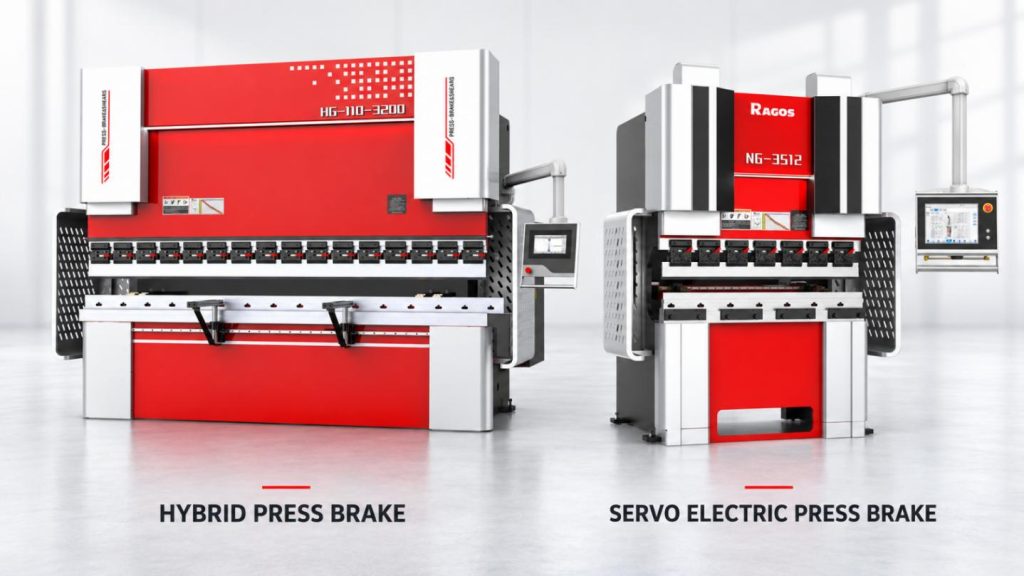
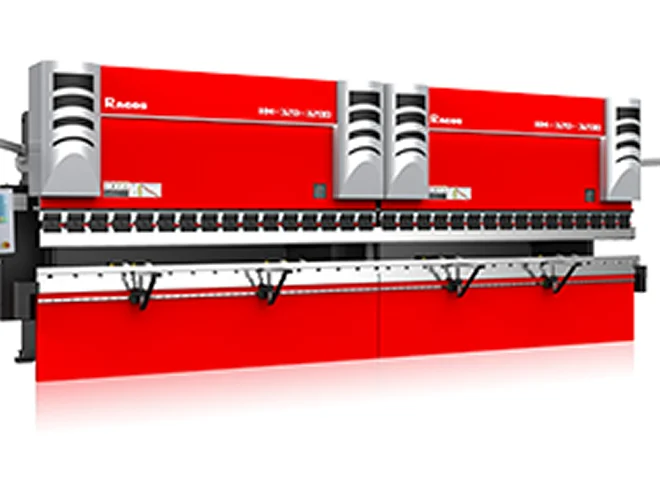
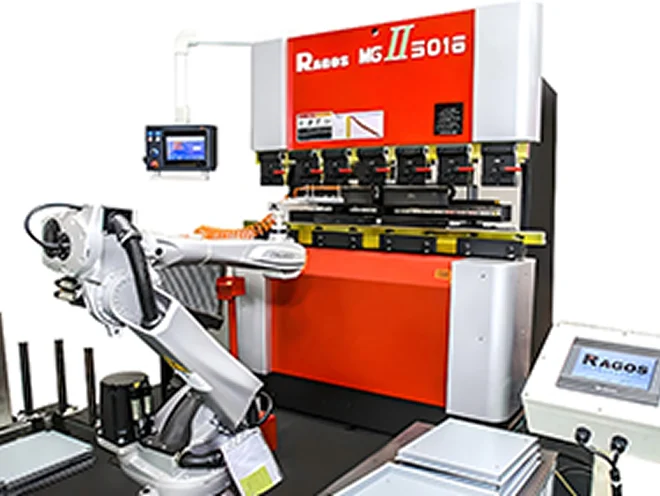
そのため, deciding on the type of drive technology for a press brake is not always straightforward. A servo electric press brake can be very effective for the production of smaller and medium-size parts, especially for repeated and continuous small-batch production with frequent start and stop cycles. A hydraulic press brake can be used for a broad range of bending and forming applications, including larger tonnages and bed lengths. Hydraulic press brakes offer greater flexibility for jobs requiring variable forming. A hybrid press brake allows for some degree of hydraulic forming and, when required, quick machine response and servo-controlled operation.
That is why a useful press brake buying guide should go beyond a simple electric vs hydraulic press brake comparison. If you want one simple rule to guide the decision, remember this order: start with the parts, define the required machine capacity, and only then choose the drive technology. When the machine type is selected before the actual workpiece and production requirements are understood, it is easy for the purchasing decision to go in the wrong direction.
What Buyers on Reddit Actually Worried About
In the original Reddit discussion, the owner of a small fabrication shop asked whether the higher purchase price of an electric press brake could be justified by savings in electricity and maintenance. 要するにあの, his electric vs hydraulic press brake decision was not only about machine performance, but also about long-term operating economics and electric press brake cost. The comments did not produce a single, clear-cut answer. 代わりに, people repeatedly asked about material thickness, 曲げ長さ, 生産量, 部品の複雑さ, and local service support. That alone says a great deal about what buyers often overlook when evaluating a first press brake.
One of the more practical points raised in the discussion was this: do not compare machines by drive type alone; compare specific machine configurations against the actual parts you need to produce. A servo electric press brake is not automatically faster in every application simply because it uses servo drives, just as a hydraulic machine is not inherently less accurate because it relies on hydraulic cylinders. A complete production cycle includes backgauge positioning, part handling, repositioning or flipping the workpiece, 停留時間, ram return, and program loading—not just the few seconds spent on the ram's fast approach.
Maintenance also cannot be reduced to a simple "oil versus no oil" comparison when evaluating an electric vs hydraulic press brake. A fully electric main drive eliminates maintenance items associated with hydraulic oil, フィルター, パンプス, バルブ, ホース, and seals. しかし, components such as ball screws, bearings, lubrication systems, servo drives, position sensors, CNC制御, and safety systems still require inspection and maintenance. Eliminating the hydraulic circuit does not make the machine maintenance-free.
Several commenters also advised buyers to try the programming software themselves and to understand exactly how service will be handled if the machine goes down. That recommendation can be more valuable than comparing headline specifications alone. For a small shop with only one first press brake, a breakdown that leaves the machine out of service for several weeks can easily wipe out an entire year's worth of energy savings.
It is important to state that one individual who promoted the use of electric press brakes in this discussion is an employee of a press brake manufacturer. While his opinions should not be disregarded, they should not be considered objective evidence. In all cases, supplier representations pertaining to potential performance and operating savings, electric press brake cost, and the time required to recover the investment should be based on samples of the parts to be fabricated and a detailed, supporting cost analysis.
電気と電気. 油圧対. ハイブリッド: 簡単な比較
| Decision Factor | Servo Electric Press Brake | 油圧プレスブレーキ | ハイブリッドプレスブレーキ |
| Typical Applications | Commonly used for small-to-medium parts, repeat jobs, and production with frequent start-stop cycles. The actual application range depends on the machine model. | Usually offers a broad application range, particularly for long parts, high-tonnage work, and sustained forming loads. | Suited to manufacturers that want hydraulic forming capability with lower idle energy use and more responsive motion control. |
| 初期投資 | Often carries a higher initial price when compared on an equivalent-capacity and equivalent-configuration basis. Actual pricing varies by brand, 地域, 自動化レベル, and included equipment, so electric press brake cost should always be compared on a like-for-like basis. | Generally offers a wider choice of new and used machines. Pricing still depends heavily on the specification and local market. | Highly dependent on the drive architecture and machine configuration. The price does not necessarily fall between electric and hydraulic machines. |
| トン数と曲げ長さ | Compact and medium-capacity machines are common, although larger electric models are increasingly available. 最大トン数, 曲げ長さ, continuous-duty capability, and off-center loading limits must be checked for each model. | Generally provides the broadest range of tonnage and bending lengths, including high-capacity and long-bed machines. | Available capacity varies considerably between manufacturers. Some hybrid product ranges extend into high-tonnage applications. |
| Energy Behavior | A fully electric main drive normally consumes most of its power while the ram is moving or bending. Actual consumption depends on the machine design and production cycle. | Conventional fixed-speed hydraulic pumps may continue running during idle periods. Modern servo-pump and on-demand hydraulic systems can substantially reduce idle losses. | The servo-controlled pump generally operates according to motion and pressure demand. Actual savings depend on the hydraulic architecture and duty cycle. |
| Main Maintenance Areas | Mechanical transmission, 潤滑, ball screws or belts, bearings, servo drives, feedback devices, CNC制御, and safety systems. | Hydraulic oil, フィルター, シール, パンプス, バルブ, ホース, cooling systems, position feedback, CNC制御, and safety systems. | Requires both servo and hydraulic expertise. Some designs use less oil and fewer conventional hydraulic components, but hydraulic maintenance is not eliminated. |
| Service Requirements | Requires access to technicians familiar with servo systems, electrical controls, CNC equipment, and mechanical transmissions. | Requires reliable hydraulic, CNCです, キャリブレーション, and general mechanical service. | Service personnel normally need experience with both servo-control and hydraulic systems. |
Start with the Parts
Before requesting quotations for a first press brake, put together a representative set of parts. Include both the jobs you are producing consistently today and the products you have a realistic chance of taking on over the next three to five years. Use the most demanding parts that you genuinely expect to make to determine the required machine capacity, then use your highest-volume routine parts to compare day-to-day productivity.
This part-first approach is one of the most important principles in any practical press brake buying guide. If you size the machine around an imagined worst-case part, you may end up paying for capacity that sits unused for years. If you look only at the easiest parts you make today, the machine may reach its limits much sooner than expected. Ideally, send the following information to suppliers together with your RFQ drawings:
•Material grade, 引張強度, and grain direction;
•Typical thicknesses, 最大厚さ, and the corresponding bend lengths;
•Inside bend radii, minimum flange lengths, and allowable V-die openings;
•Angular tolerances, dimensional tolerances, number of bends, and bending sequence;
•Annual production volume, バッチサイズ, and expected operating hours per day;
•Special forming operations such as hemming, offset bending, radius forming, or multi-step bump bending;
•Off-center loading conditions and the handling method for the heaviest parts.
You can use the JS RAGOS press brake tonnage calculator as a preliminary estimate of the force required for air bending. Final machine selection, しかし, should also account for material strength, Vダイオープニング, tooling load limits, actual loaded length, off-center load restrictions, and the rated capacity of the specific machine. These requirements should be established before narrowing the choice to a servo electric press brake, hydraulic press brake, or hybrid press brake.
Compare Equivalent Machines
Online searches often place manual bending tools, older used hydraulic machines, entry-level CNC press brakes, and brand-new servo-electric models on the same results page. Their prices may differ severalfold, but they are not direct substitutes for one another. This is one reason an electric vs hydraulic press brake price comparison can be misleading when the machines are not equivalent. The lowest advertised machine price is also not the same as the total cost of putting the machine into production. ツーリング, クランプシステム, software, 貨物, taxes, rigging, electrical work, 訓練, and commissioning may all be quoted separately.
Ask every shortlisted supplier to quote against the same set of drawings and acceptance criteria, and verify the following items line by line:
•Usable bending length, 必要トン数, and continuous-duty capability;
•Daylight/open height, ストローク, 喉の深さ, and frame rigidity;
•Number of backgauge axes, positioning specifications, and crowning system;
•CNC control, オフライン番組, and program import capabilities;
•Tooling, clamping system, and angle-measurement options;
•Applicable safety standards, guarding concept, and operating restrictions;
•Installation, 訓練, 保証, commissioning, and scope of local service.
If the basis of comparison is inconsistent, much of the price difference may come from configuration rather than from the electric or hydraulic drive itself. The same principle applies when calculating electric press brake cost against the price of a comparable hydraulic press brake.
What Motion Control Changes on an Electric Press Brake
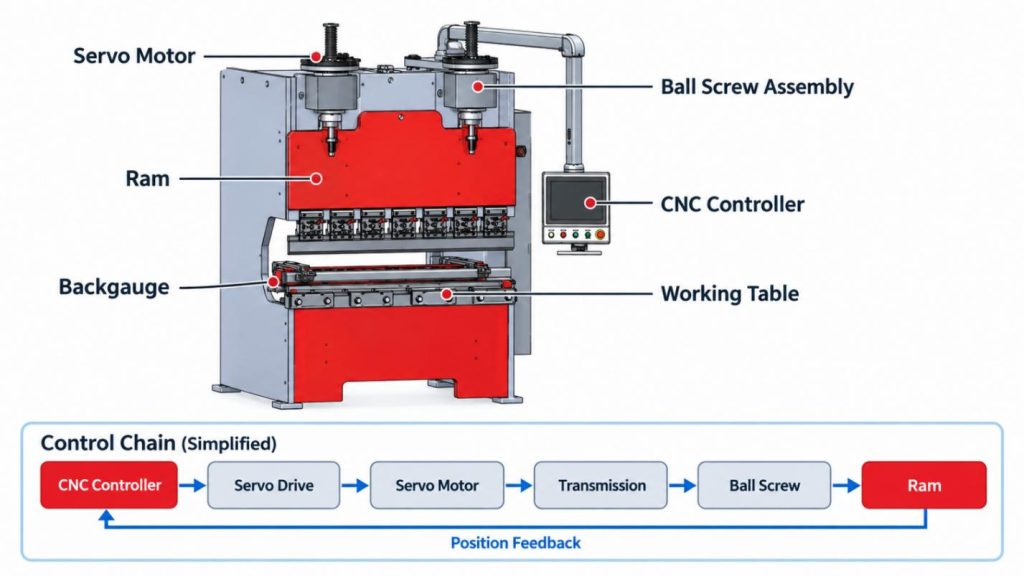
The technical value of a servo electric press brake goes beyond eliminating hydraulic oil. In a design using dual servo motors and ball screws, 例えば, ram motion depends on how well the motors, servo drives, mechanical transmission, position feedback, and left-right synchronization work together. Backlash, slow response, or measurement error in any part of that chain can affect the performance of the entire system.
For buyers making an electric vs hydraulic press brake comparison, this means that the drive label alone says relatively little about actual motion quality. The architecture and integration of the complete motion-control system matter more.
S-curve Acceleration and Deceleration
When the ram transitions from fast approach to bending speed, an abrupt change in acceleration can increase shock and vibration. S-curve acceleration and deceleration smooths these speed transitions and reduces the mechanical impact of sudden starts and stops on the frame and drive components.
Buyers do not need to judge a servo electric press brake by the name of a particular motion-control algorithm. A more useful test is to ask the supplier to demonstrate fast approach, deceleration, ベンディング, dwell, and return using the actual stroke and real sample parts. Watch the machine for vibration, stopping position, and consistency over repeated cycles.
Closed-loop Position Control
Closed-loop position control continuously reads the actual ram position, compares it with the commanded position, and corrects the motion according to the measured error. Buyers evaluating a servo electric press brake should ask for more detail: Where is the feedback device installed? Does it measure motor-side position or actual ram position? How is repeatability defined? How does the system compensate for backlash, elastic deformation, and load disturbances?
The resolution displayed by the CNCです is not the same as the machine's positioning capability under load, and neither one is the same as the final angle accuracy of the workpiece. Any accuracy figure in a quotation should state the measurement conditions, measurement location, and number of repetitions.
Y1/Y2 Synchronization
On a dual-drive press brake, the left and right sides do more than reach the same final position. They should remain synchronized as closely as possible throughout the entire stroke. This is particularly important when assessing the design of a servo electric press brake. If the deviation between the two sides continues to increase, ram parallelism, left-to-right bend depth, angle consistency, and loads on the drive components may all be affected.
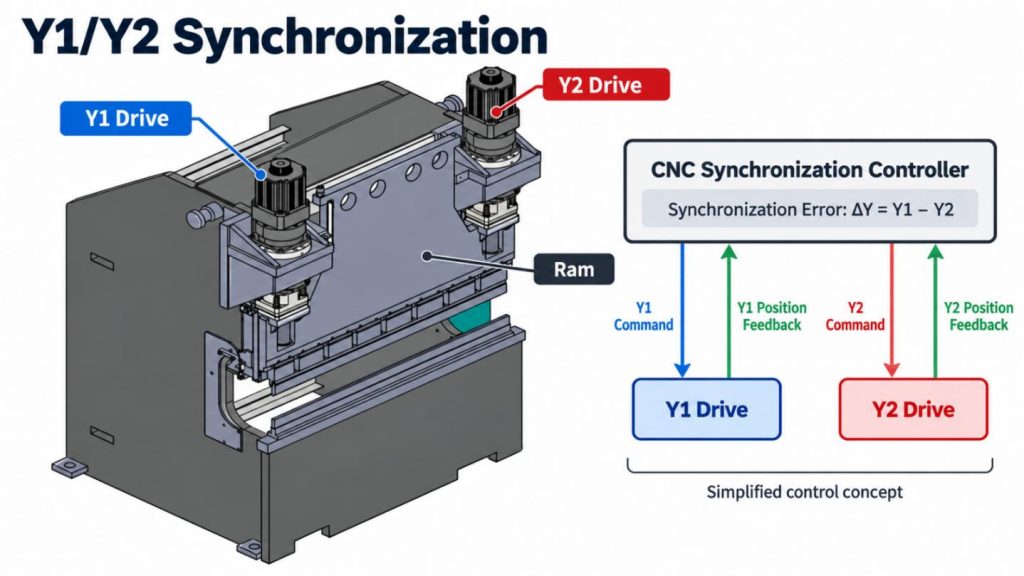
Synchronization errors can be caused by a number of factors including: difference in mechanical properties between the two sides of the machine, differences in assembly, flexibility of the frame, conditions of the ball screws, and unexpected changes in speed. When considering a purchase, determine the feedback devices on each side of the machine, the nature of the control system to correct deviation, and the conditions of off-center loading that are permitted.
Ball-Screw Transmission
In a ball-screw system, a servo motor is used to drive a ball screw to create linear motion of a ram. This arrangement is common in some servo electric press brake designs. Compared to other mechanical systems, it provides excellent control of linear position and is generally considered to be a high-efficiency system. しかし, the ball screw is also a load-bearing component, so it is not enough simply to know that the machine uses one. Buyers should ask about rated load, bearing arrangement, lubrication requirements, inspection intervals, replacement cost, and local spare-parts availability.
要するにあの, asking whether a machine "uses servo motors" is only the beginning. How the motors, transmission, ボールスクリュー, position feedback, and dual-axis synchronization are integrated—and who can service them when something fails—has a much greater impact on long-term ownership and the true electric press brake cost.
Cycle Time Is More Than Ram Speed
Maximum approach speed is only one part of a complete bending cycle. This is a key point in any electric vs hydraulic press brake productivity comparison. Total cycle time also includes backgauge movement, operator part handling, program changes, transitions to safety speed, the bending stroke, 停留時間, return stroke, and part repositioning or flipping. High-tonnage electric machines may also be limited by transmission design or continuous-duty capability, while modern hydraulic machines can reduce cycle time through on-demand power, optimized stroke control, and smoother safety sequences.
During testing, use the same material, ツーリング, ベンドシーケンス, and safety settings, and run a continuous batch of representative parts. 高混合用, low-volume shops, also record programming and tool-change time. A single no-load ram cycle does not provide a reliable measure of real production efficiency for a servo electric press brake, hydraulic press brake, or hybrid press brake.
Energy Savings Depend on Utilization
Electric press brakes are generally more energy-efficient in applications with frequent stops and starts or significant idle time because the main drive does not need to keep hydraulic oil circulating continuously. This is often one of the first advantages considered in an electric vs hydraulic press brake comparison. しかし, an energy-saving percentage is meaningful only when the machine model, reference machine, and test conditions are clearly defined.
AMADA’s EG-4010 launch material reports a 72% reduction in power requirement relative to its stated hydraulic comparison. This model-specific figure should not be interpreted as a guaranteed reduction in annual electricity consumption.
同時に, modern hydraulic technology is also reducing idle losses. Some TRUMPF servo-hydraulic systems stop the hydraulic system when motion is not required, while certain Bystronic models use energy-saving functions that activate the main drive only when the machine is actually operating. See the respective TRUMPF product information and Bystronic product information for details.
Annual electricity cost can be estimated as:
Measured average power consumption × Annual production hours × Local electricity rate
Whenever possible, ask suppliers to provide measured energy consumption using the same sample parts and the same cycle conditions. Do not compare machines simply by motor nameplate power. At low machine utilization, the difference in electricity cost may take a long time to offset a higher electric press brake cost. Under two-shift operation or applications with frequent start-stop cycles, the gap may become much more significant.
Maintenance Is a Service Question
A fully electric main drive has no primary hydraulic circuit, so it does eliminate tasks associated with hydraulic oil changes, filter replacement, パンプス, バルブ, ホース, シリンダーシール, and oil leakage. This maintenance difference often receives significant attention in an electric vs hydraulic press brake evaluation. The advantage becomes more significant in regions where hydraulic service labor is expensive or waste-oil disposal requirements are strict.
Electric machines still require maintenance of guideways, ボールスクリュー, bearings, and lubrication systems, as well as periodic inspection of the backgauge, position sensors, safety devices, electrical cabinet cooling, CNC制御, and servo system. A hydraulic press brake should not be characterized broadly as unreliable either. A well-designed hydraulic system that is maintained according to schedule can provide stable service for many years.
A useful purchasing exercise for a first press brake is to ask each supplier for a five-year maintenance plan showing service intervals, wear-part prices, lead times for critical spare parts, field-service charges, and expected downtime. That kind of table is far more useful than a brochure claim such as "low maintenance."
Positioning Accuracy Is Not Finished-part Accuracy
A servo electric press brake can provide excellent ram-position repeatability and fast response, but returning the ram to the same position does not guarantee that every sheet will bend to the same angle. Variations in material thickness and tensile strength, 結晶方向, スプリングバック, Vダイオープニング, 工具の摩耗, フレームのたわみ, crowning settings, backgauge performance, angle-measurement systems, and operator setup can all affect the finished part.
With suitable position feedback, 戴冠, temperature compensation, and angle measurement, modern hydraulic press brakes can also achieve excellent real-world forming accuracy. This is why an electric vs hydraulic press brake comparison should distinguish machine-axis positioning specifications from actual finished-part accuracy. 逆に, if the frame, ツーリング, キャリブレーション, or feedback architecture is inadequate, servo motors alone cannot guarantee acceptable parts.
The most reliable acceptance test is to run a continuous batch using the buyer's own material and drawings, then inspect the parts against dimensional and angular tolerances agreed in advance. The number of decimal places shown on the CNC screen is no substitute for a finished-part inspection report.
Software and Local Service Can Decide the Purchase
Operators interact every day with the CNC interface, ツールライブラリ, and bending workflow—not with the drive-system diagram in a sales brochure. This is particularly important when selecting a first press brake. During a demonstration, give the supplier a real part drawing and ask them to start from drawing creation or file import, then complete tool selection, ベンドシーケンス, 衝突検査, 部品ひっくり返し, 戴冠, angle correction, program saving, and program recall.
In high-mix, 低量生産, eliminating a few programming steps can be more valuable than saving one second on a single ram stroke. If the software is difficult to learn, programs are hard to migrate, or offline programming requires a substantial recurring subscription, those costs should be understood before the purchase and included when assessing total electric press brake cost or hydraulic machine ownership cost.
Service questions should also be tied to specific failures. Who diagnoses a servo-drive alarm, failed position sensor, ball-screw problem, safety-system shutdown, hydraulic leak, or pump failure? How quickly is remote support available? Are critical spare parts stocked locally? If this will be the shop's only press brake, those answers matter more than the maximum speed shown on the specification sheet.
When Electric Is Worth the Premium
A servo electric プレスブレーキ is more likely to justify its premium when the shop's regular work falls comfortably within the machine's tonnage and bending-length range, particularly when production consists largely of small to medium-sized parts, repeat jobs, and components with multiple bends. Frequent start-stop operation, high annual machine hours, and high electricity rates or peak-demand charges can further strengthen the case for on-demand power consumption. Shops with strict requirements for noise, cleanliness, or hydraulic-oil management may also have good reasons to evaluate electric technology seriously.
The condition is that reliable local support must be available for the servo, CNCです, and mechanical transmission systems, and the manufacturer should be willing to document dual-axis feedback, allowable off-center loading, continuous-duty capability, and critical component pricing. Once those points are established, cycle-time savings, electricity savings, and maintenance differences can be placed into a five-year cost model to determine whether the additional electric press brake cost is justified.
For available specifications, see the JS RAGOS electric press brake product page and submit actual part drawings so that tonnage, ツーリング, and control configuration can be checked against your application.
When Hydraulic Is the Safer First Machine
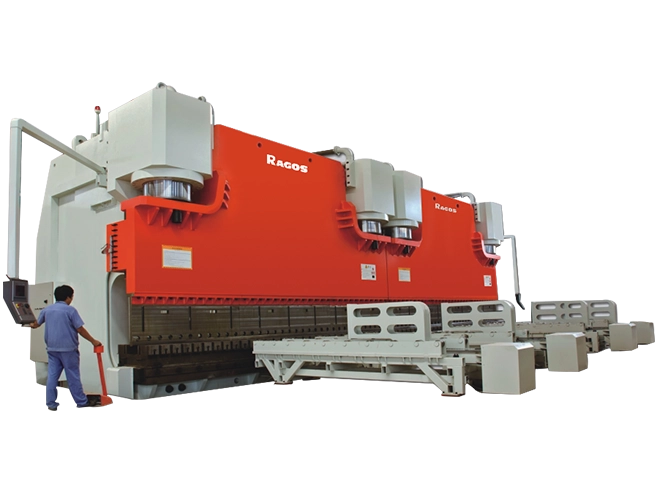
If the main workload consists of long parts, 厚いプレート, or sustained heavy-duty bending, a hydraulic press brake generally offers a broader selection of tonnage capacities and bed lengths. For job shops with an unpredictable order mix, that wider processing envelope can be valuable in itself. Hydraulic equipment may also be the more practical option for a first press brake when initial capital is limited or when local hydraulic service and spare-parts support are significantly stronger than local servo expertise.
Modern hydraulic press brakes are not necessarily comparable to older designs that ran their hydraulic systems continuously at idle. With on-demand servo-pump technology, standby energy consumption, 騒音, and heat generation can all be reduced. このため, experience with older machines should not be used to characterize every new hydraulic press brake. In a current electric vs hydraulic press brake comparison, the actual drive architecture of the specific hydraulic model matters. The JS RAGOS CNC press brake product page can serve as a reference for available configurations, but the final comparison should still be based on sample parts and specific machine models.
When Hybrid Makes Sense
A hybrid press brake typically uses servo-controlled pumps to power hydraulic cylinders that move the ram. It retains hydraulic forming architecture while allowing the motor and pump to operate according to actual demand. For small and medium-sized fabrication shops with a broad mix of jobs that also want to reduce idle energy consumption and noise, a hybrid press brake is worth including in the same round of testing.
Hybrid technology does not eliminate hydraulic maintenance, and it also introduces servo-system service requirements. The comparison should therefore include oil volume, continuous-load performance, pump and drive replacement costs, local technical capability, and the price of the complete machine configuration. A hybrid press brake should not simply be assumed to combine all of the advantages of electric and hydraulic designs without trade-offs.
Use a Five-year Ownership Model
Five-year total cost of ownership can be calculated by adding purchase and installation costs, electricity, preventive maintenance, expected repairs, tooling and software, and downtime losses, then subtracting the estimated residual value. For an electric vs hydraulic press brake comparison, this model is more useful than looking at purchase price alone.
Do not build only one idealized scenario. 最低でも, model low utilization, expected utilization, and high utilization, and document every assumption in the spreadsheet. If an electric machine recovers its price premium only under high utilization while the shop's actual order book is closer to the low-utilization case, a hydraulic or hybrid machine may expose the business to less financial risk. This is also the most practical way to evaluate whether the higher electric press brake cost can be recovered in real production.
The cost model should include at least:
•Machine price, 貨物, taxes, rigging, and electrical installation;
•Tooling, クランプシステム, 訓練, and offline programming software;
•Annual production hours, idle hours, electricity rates, and demand charges;
•Hydraulic oil, フィルター, シール, 潤滑, and scheduled inspections;
•Servo drives, position sensors, ボールスクリュー, and critical bearings;
•Field-service travel, 労働, 予備部品, and downtime losses;
•Warranty coverage, exclusions, and estimated residual value after five years.
Where a supplier cannot provide an exact figure, enter a reasonable range rather than leaving the field blank. An unknown cost is not a zero cost.
最終推奨事項
A first press brake should be selected around real parts first, realistic future work second, and drive technology third. そのため, the final electric vs hydraulic press brake decision should come after tonnage, 曲げ長さ, ワークフロー, service requirements, and expected utilization have been defined. A servo electric press brake is well suited to shops producing a high proportion of small and medium-sized repeat parts, operating with frequent start-stop cycles, and having access to dependable servo-system support. A hydraulic press brake generally provides more flexibility for high tonnage, long workpieces, heavy-duty applications, and highly variable job mixes. A hybrid press brake can be attractive to buyers who need a relatively broad processing range while also placing value on lower standby energy consumption and responsive motion.
Give the same sample parts to every shortlisted supplier. Record total cycle time, finished-part accuracy, and measured energy consumption. Then request a maintenance plan, a software demonstration, and written service commitments. A good press brake buying guide should lead the buyer to this type of like-for-like evaluation. At that point, the most suitable machine is usually much easier to identify without relying on slogans such as "electric is always more advanced" または "hydraulic is always more reliable."
Send Your Drawings for a Machine Recommendation
If you are still unsure which configuration best fits your operation, you can submit your drawings and production requirements to JS RAGOS. This is especially useful when comparing a servo electric press brake, hydraulic press brake, and hybrid press brake for a first press brake purchase. Provide as much information as possible about material, 厚さ, 曲げ長, part drawings, annual volume, 公差, and special forming requirements so that the required tonnage, ツーリング, 軸の構成, control system, and drive technology can be evaluated.
よくある質問
Q1: Is a Servo Electric Press Brake Always More Accurate?
必ずしもそうとは限りません. A servo electric press brake can provide excellent ram-position repeatability, but finished-part angle accuracy is still affected by the frame, feedback devices, dual-axis synchronization, 戴冠, ツーリング, 素材の変異, スプリングバック, および機械のセットアップ. Repeated test bends using your own material are more meaningful than positioning specifications alone, particularly when making an electric vs hydraulic press brake comparison.
Q2: Why Is Y1/Y2 Synchronization Important?
The left and right sides of a dual-drive press brake need to remain synchronized throughout the entire stroke. Excessive deviation can affect ram parallelism, left-to-right bend depth, and angle consistency. This is an important specification to verify on a servo electric press brake. Buyers should confirm the feedback method, correction strategy, allowable deviation, and off-center loading limits.
Q3: What Does Closed-loop Control Mean?
The control continuously reads the actual position, compares it with the commanded position, and adjusts the motion according to the error. To understand how effective the system really is, buyers should also know where the feedback device is mounted, how repeatability is measured, and how the machine compensates for load effects and structural deformation. These details can be useful when comparing the motion-control architecture of an electric vs hydraulic press brake.
Q4: Why Do Some Electric Press Brakes Use Ball Screws?
Ball screws convert the rotary motion of the servo motor into the linear motion required by the ram and are commonly used in some servo electric press brake designs. They offer high transmission efficiency and support precise position control. They are also load-bearing components, so they require proper lubrication and inspection. Buyers should understand the price and lead time of replacement ball screws, bearings, and related components because these items can affect long-term electric press brake cost.
Q5: Does an Electric Press Brake Use Less Power?
Compared with a conventional hydraulic press brake that keeps its pump running continuously, an electric machine will generally consume less energy in applications with significant idle time and frequent start-stop operation. The actual difference depends on machine size, drive architecture, utilization, and local electricity rates. Modern hydraulic and hybrid systems using on-demand power can narrow the gap considerably. このため, energy use in an electric vs hydraulic press brake comparison should be measured under the same production cycle.
Q6: Is an Electric Press Brake Maintenance-free?
いいえ. A servo electric press brake can eliminate maintenance items associated with hydraulic oil, フィルター, パンプス, バルブ, ホース, and cylinder seals, but the mechanical transmission, lubrication system, ボールスクリュー, bearings, servo system, position sensors, CNC制御, safety devices, and tooling still require regular inspection and maintenance. These maintenance requirements should be included when calculating electric press brake cost.
Q7: Is a Hydraulic Press Brake Better for Heavy Work?
A hydraulic press brake generally offers more choices at higher tonnages and longer bed lengths, which often makes it a practical fit for thick plate and large workpieces. Final selection should still be based on calculated bending force, tooling load capacity, actual loaded length, continuous-duty requirements, and off-center loading limits rather than drive type alone.
Q8: Which Type Is Better for a Small Fabrication Shop?
It depends on the job mix. If the shop produces a high proportion of small and medium-sized repeat parts, a servo electric press brake is worth prioritizing in the comparison. If the parts vary widely in size, require higher tonnage, or involve long bend lengths, a hydraulic press brake generally offers greater flexibility. If the goal is to balance a broad processing range with lower standby energy use and responsive motion, a hybrid press brake should also be included in the evaluation. For a first press brake, the best electric vs hydraulic press brake comparison is therefore one based on actual parts, realistic production volume, local service, and five-year ownership cost.