


Large Tonnage Press Brake: The Complete Selection Guide for Heavy-Duty Bending
A large tonnage press brake is not simply a bigger version of a standard machine — it is an entirely different class of equipment, built for material thicknesses, Lunghezze delle curve, and force demands that standard press brakes cannot meet. This guide introduces a clear four-class tonnage framework to help you match the right machine to your specific application. By the end, you will know which tonnage class fits your work, what specifications to evaluate, and what configuration to request from your supplier.
What Counts as Large Tonnage in a Press Brake
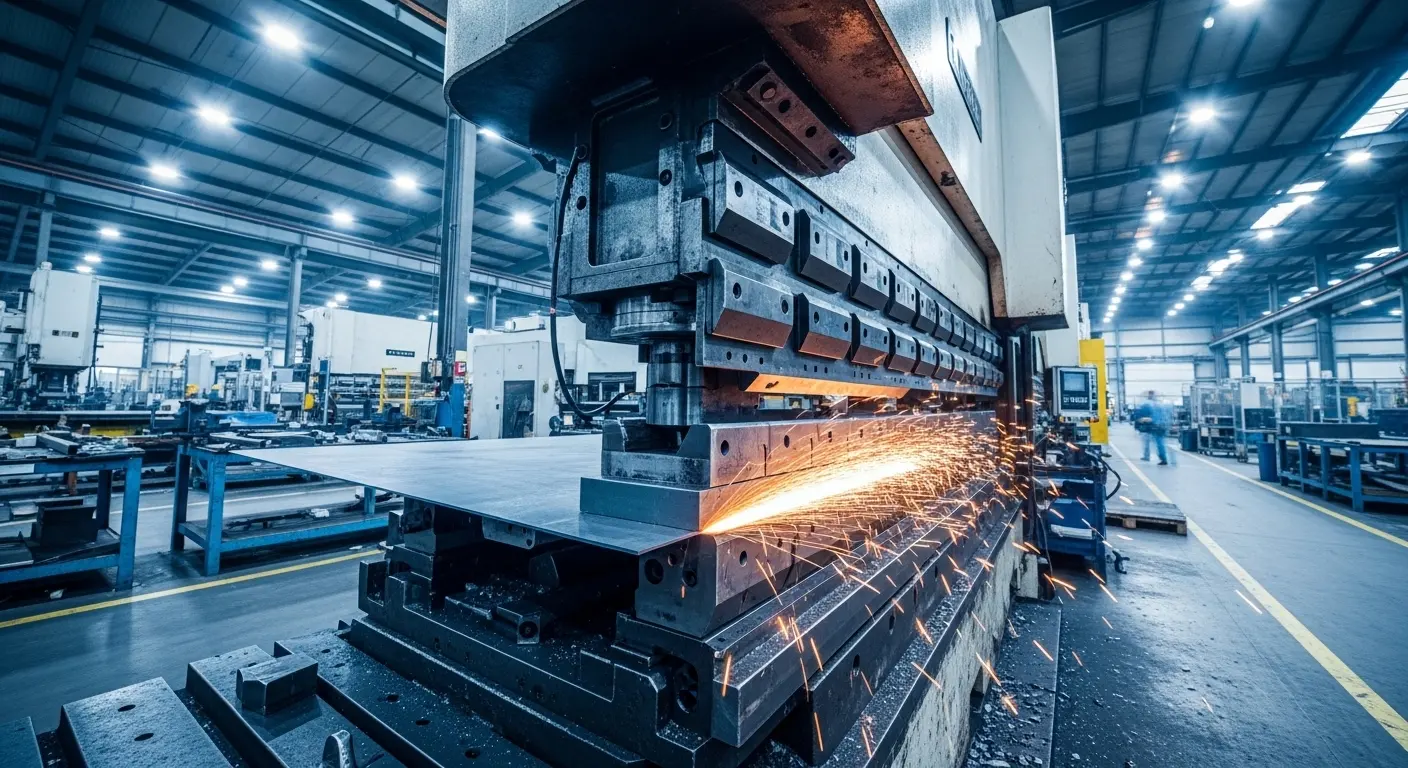
Large tonnage press brakes start at 300 tonnellate. Most fabrication shops operate in the 100–400-ton range for everyday work, but 300T marks the threshold where machine design, frame engineering, and CNC system requirements shift significantly.
To make selection easier, the industry can be divided into four practical classes:
| Classe | Intervallo di tonnellaggio | Typical Plate Thickness | Primary Use |
|---|---|---|---|
| Heavy | 300–499T | 6–12mm | Structural steel, construction components |
| Super-Heavy | 500–799T | 12–20mm | Vasi a pressione, heavy machinery |
| Ultra-Heavy | 800–1,499T | 20–35mm | Wind towers, large industrial frames |
| Mega | 1,500T+ | 35mm+ | Cantieristica navale, tandem configurations |
No competitor article defines these classes this way — and most buyers end up over-specifying or under-specifying because no one has drawn these lines clearly before.
Industries That Depend on Large Tonnage Press Brakes
Large tonnage press brakes serve industries where material thickness and part size exceed the limits of standard equipment. The global press brake machine market sits at USD 800.2 milioni in 2026 e si prevede che raggiungerà il dollaro americano 1,211.2 million by 2033 — growth driven almost entirely by heavy industrial demand.
The key sectors and their tonnage requirements are:
- Cantieristica navale — Hull plating and bulkhead panels; typically 500T to 2,000T+
- Wind energy — Tower flanges and base plate rings; typically 800T to 1,500T
- Heavy construction — Structural beams, Colonne, and bridge components; typically 400T to 800T
- Railway and transportation — Bogie frames and car body panels; typically 300T to 600T
- Pressure vessels and petrochemical — Thick-wall cylinder shells; typically 600T to 1,200T
- Heavy equipment manufacturing — Crane arms, excavator frames; typically 400T to 800T
Why Standard Machines Fall Short
A standard press brake cannot sustain the frame rigidity needed under repeated extreme loads. At full bed length, even rated-capacity machines derate to 60–70% of their stated tonnage — meaning a 250-ton standard machine may only deliver 150–175 effective tons across a long bend. Large tonnage machines are engineered with reinforced side frames, precision-ground guideways, and active crowning systems specifically to hold accuracy under these conditions.
Le 4 Tonnage Classes Explained
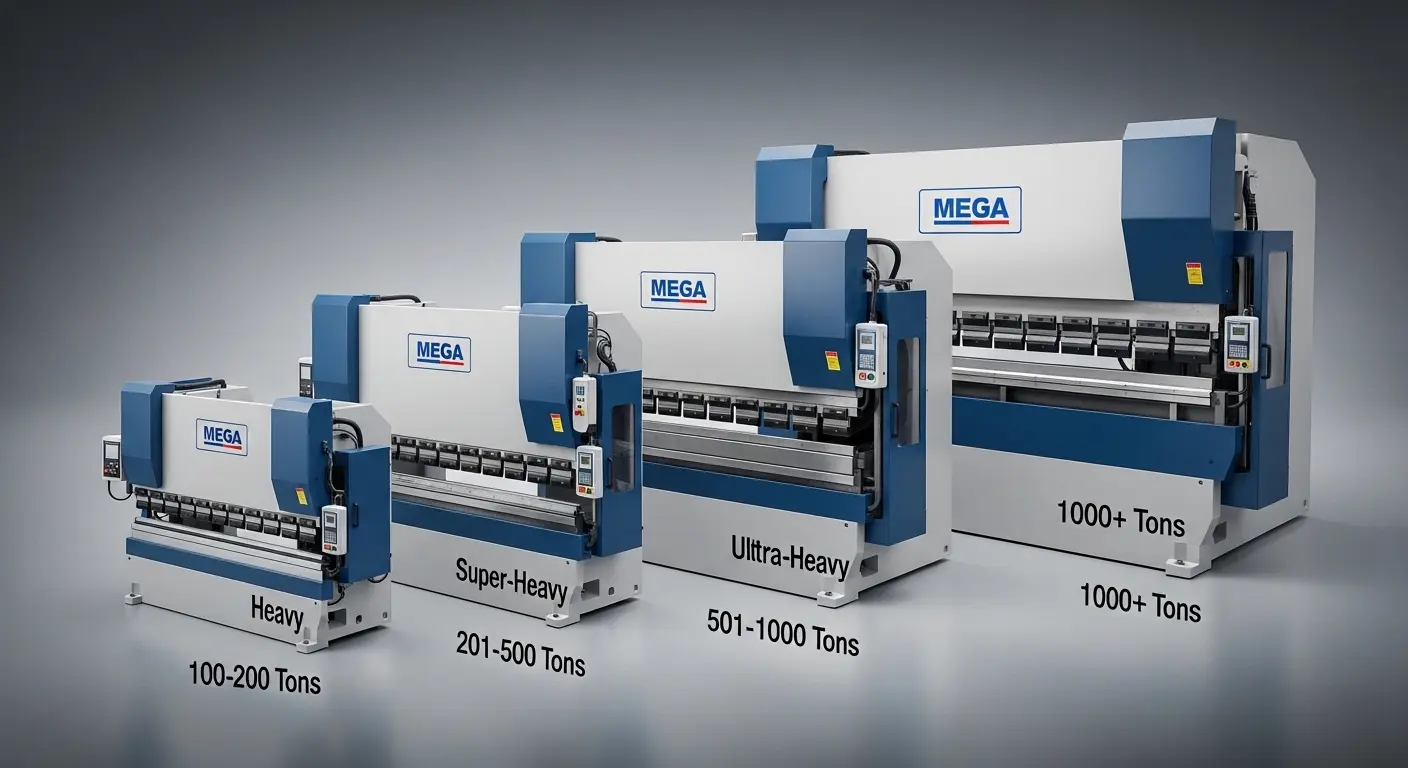
Understanding which class fits your work prevents both under-investment and overcapacity. Each class carries different machine design requirements, control system demands, and tooling standards. CNC press brakes are available from 40 tons for light-gauge work all the way to over 2,000 tons for heavy plate operations.
Heavy Class (300–499T)
The Heavy Class covers the majority of structural steel fabrication shops. These machines handle 6–12mm mild steel or 4–8mm stainless at bend lengths of 3–5 meters. They are the entry point for bridge sub-components, heavy cabinet frames, and large agricultural equipment panels.
A buyer in this class needs a hydraulic or hybrid servo-hydraulic drive. Full electric press brakes are not commercially viable at this tonnage range today.
Super-Heavy to Mega Class (500T and Above)
Above 500T, hydraulic drive is the standard. Machines in this range are built on heavier steel weldments, run larger cylinder bores, and require active hydraulic crowning to maintain angle consistency across long bends.
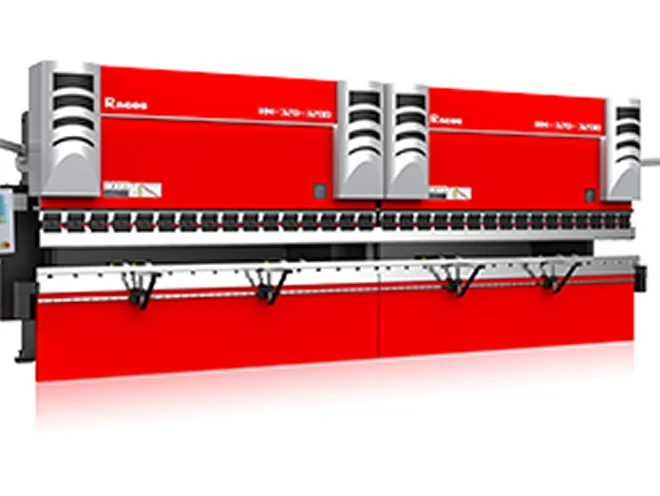
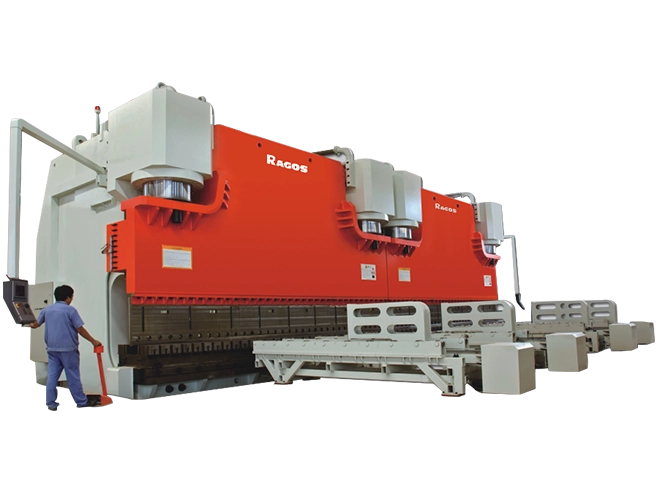
The Mega Class (1,500T+) almost always involves tandem or synchronized configurations. A 6,500-ton / 18-meter tandem CNC press brake has been successfully developed and deployed for ultra-large shipbuilding applications — one of the largest configurations in the world.
Class Comparison Table
| Classe | Stazza | Spessore della lastra | Lunghezza del letto | Config | Meglio per |
|---|---|---|---|---|---|
| Heavy | 300–499T | 6–12mm | 3–5m | Singolo | Structural steel, Costruzione |
| Super-Heavy | 500–799T | 12–20mm | 4–7m | Singolo | Vasi a pressione, Macchinari |
| Ultra-Heavy | 800–1,499T | 20–35mm | 6–10m | Singolo / Tandem | Wind towers, offshore |
| Mega | 1,500T+ | 35mm+ | 10m+ | Tandem | Cantieristica navale, Placca pesante |
Machine Types Used for Large Tonnage Bending
Not all large tonnage press brakes use the same drive system. The right type depends on your tonnage class, Volume di produzione, and part complexity.
- Hydraulic CNC press brake — the dominant type above 300T; delivers consistent force across full bed length; preferred for 500T+ due to proven reliability under extreme load
- Hybrid servo-hydraulic — available up to approximately 400–500T; offers energy savings over full hydraulic; suitable for shops that mix thick and medium plate work
- Tandem press brake — two synchronized machines operating in parallel; used when a single machine cannot cover the required bed length; common above 8 Metri
- Full electric press brake — not yet commercially available above 300T in standard production; limited to lighter applications
In the 300–500T and above 500T market segments, hydraulic remains the dominant drive category.
When to Choose Tandem Over a Single Large Machine
A tandem setup makes sense when your bend lengths consistently exceed 8 Metri, your part geometry prevents a single-machine approach, or your production volume demands simultaneous bending of multiple components. The tradeoff is floor space, synchronization complexity, and initial investment. In our experience assessing heavy-fabrication configurations, buyers in shipbuilding and offshore wind almost always move to tandem above 6-meter bend requirements — a single 1,000-ton machine at that length would require a bed engineering spec most standard suppliers cannot meet.
Key Specifications to Evaluate Before Buying
Selecting a large tonnage press brake on rated tonnage alone is the most common buyer mistake. Several specifications matter equally — and some directly affect how much usable force you actually get. For a detailed breakdown by machine size, Lepress brake capacity guide covers the core specs in full.
Tonnage Calculation for Thick Plate
The DIN standard formula for bending force is:
F=1.54×Rm×S2×LV×1000 kNF=V×10001.54×Rm×S2×L kN
Where Rm = tensile strength (MPa), S = thickness (millimetro), L = lunghezza della curva (millimetro), V = V-die opening (millimetro).
For a practical example: bending 20mm mild steel (Rm = 400 MPa) at 3,000mm length with a 160mm V-die opening gives approximately 924 kN (94 tons per meter × 3m). Add the recommended 30–50% overhead buffer, and you need a machine rated at a minimum of 400T for this job alone. Use the tonnage calculator to run your own figures before specifying.
Key specifications to check beyond rated tonnage:
- Usable tonnage at full bed length — derate to 60–70% of rated at full bed
- Lunghezza del letto — standard 4–14 feet; custom lengths required above that
- Stroke length and open height — critical for large tooling clearance
- Frame rigidity rating — the single most overlooked spec in large tonnage; unwavering frame stiffness preserves accuracy under extreme load
- Sistema di coronazione — active hydraulic crowning is non-negotiable at 500T+
CNC Control Systems on Large Tonnage Press Brakes
A large tonnage machine without the right CNC system loses much of its precision advantage. Control system selection directly affects bend repeatability, Tempo di preparazione, and automation readiness.
- Delem DA66S — 2D/3D graphical touch-screen programming, 24" Display TFT, sensor bending and correction interface; the preferred system for complex thick-plate work and Super-Heavy to Ultra-Heavy class machines
- Delem DA53T — 15" touch-screen, solid for standard Heavy Class production runs with crowning control and closed/open-loop valve support
- ESA S840/S850 — up to 6 Assi, EtherCAT/CANopen interface, real-time OS; used in automated heavy-tonnage production lines
For machines above 500T, a minimum of 4-axis backgauge control is recommended. Complex part programs with multiple bend sequences require the additional axis flexibility to position thick plate accurately between bends. Le4-vs-8-axis guide explains axis configuration in detail for buyers weighing automation investment.
How to Select the Right Large Tonnage Press Brake
Follow this six-step framework to reach the right specification:
- Calculate your maximum bending force — use the DIN formula above with your thickest material, longest bend, and tightest die opening
- Add a 30–50% tonnage buffer above that calculated maximum
- Match your result to a tonnage class — use the class table above to identify Heavy, Super-Heavy, Ultra-Heavy, or Mega
- Decide: single machine or tandem — if your bend length regularly exceeds 8 Metri, tandem is the practical answer
- Select your CNC system — DA66S for complex geometry; DA53T for production runs; ESA S840 for automation integration
- Verify frame rigidity and bed derating spec — ask your supplier for the usable tonnage at full bed length, not just rated capacity
Based on assessments of heavy-fabrication projects, the biggest mistake buyers make is specifying for today's job, not the next five years of planned capacity. A machine that runs at 90% of rated tonnage daily will wear faster and hold less accuracy over time. Buying one class above your current maximum job is rarely a bad decision when the machine will run for 20+ anni.
Esplora ilheavy-duty press brake configurations or the 300-Freno a pressione CNC tonnellate as starting points for the Heavy Class. For the full CNC press brake product range, LeCNC press brake overview covers all available configurations.
Domande frequenti
Q1: What is considered large tonnage for a press brake?
Large tonnage press brakes are generally defined as machines rated at 300 tons or above. Most standard fabrication shops operate in the 100–400-ton range, making 300T the point where machine design, frame engineering, and CNC requirements shift to heavy-duty specifications. Machines above 1,500T are typically tandem configurations used in shipbuilding and offshore industries.
D2: What industries use large tonnage press brakes?
The primary industries are shipbuilding, Energia eolica, heavy construction, pressure vessel manufacturing, railway equipment, and heavy machinery production. Each sector has different tonnage requirements — shipbuilding often demands 500T to 2,000T+, while structural construction work typically falls in the 400T to 800T range.
D3: What is the difference between a 300-ton and 500-ton press brake?
A 300-ton machine handles 6–10mm plate at standard bed lengths and suits structural steel fabrication. A 500-ton machine enters the Super-Heavy class, handling 12–20mm plate with longer bed lengths, and is built with heavier frame construction and larger hydraulic cylinders. The CNC system requirements and tooling specifications also differ significantly between the two classes.
D4: Can a large tonnage press brake also handle thin sheet metal work?
Technically yes, but it is not ideal. Operating a 500T machine at 5% of its capacity creates control sensitivity challenges and increases die wear risk on thin material. For shops that run both thick plate and thin sheet work, a two-machine approach — one large tonnage and one standard — is far more practical and cost-effective.
Q5: What is the largest press brake ever built?
A 6,500-ton / 18-meter tandem CNC press brake has been developed for ultra-large shipbuilding applications. This configuration represents the upper boundary of current commercial press brake engineering and is used for bending hull plates and structural sections that no single-machine setup can handle.
What to Do Next
Large tonnage press brake selection comes down to three things: the right tonnage class for your material and application, a machine configuration that matches your bend length requirements, and a CNC system that fits your production complexity. Hydraulic drive dominates above 300T for good reason — reliability and force consistency under extreme load are non-negotiable. Before contacting a supplier, calculate your required force, add 30–50% overhead, and identify whether a single machine or tandem setup fits your facility. LeGamma di freni a pressione pesante at JS RAGOS covers the Heavy to Ultra-Heavy classes with full CNC configuration options.