高速進入速度プレスブレーキ: サイクルタイムと出力に与える意味
プレスブレーキのスペックを比較するなら, fast approach speed press brake performance is one of the clearest indicators of real-world productivity. The approach speed — the rate at which the ram travels from its top position down to the material — determines exactly how much dead time sits between every bend. Cut that dead time, and your output rises across every shift without changing anything else.
This guide explains what approach speed actually means, how it differs across machine types, and what numbers to look for when buying.
What Is Fast Approach Speed in a Press Brake?

Afast approach speed press brake moves its ram rapidly from top dead center down to the "ミュートポイント" — the exact position just above the material where the machine transitions to the slower bending speed. This entire phase applies zero bending force. It is purely transit.
Approach speed is measured in millimeters per second (mm/s). Modern press brakes typically deliver approach speeds between 100 mm/s and 250 mm/s, depending on drive system and machine tier. High-end electric models can exceed 250 mm/s, while conventional hydraulic machines generally range from 100 宛先 180 mm/s.
The three distinct ram speed phases are:
- Approach speed — fast transit, no force, 100–250 mm/s
- 曲げ速度 — slow and controlled, typically 1–15 mm/s
- 帰還速度 — fast retraction, 100–200 mm/s
The approach phase contributes most to cycle time on jobs with a long stroke. Deep-box bending, for instance, requires a large open height — meaning the ram travels a significant distance before ever touching the material. In those jobs, afast approach speed press brake recovers time no other setting can.
Why Fast Approach Speed Press Brake Performance Matters for Output
Short answer: the time savings add up fast. Consider a shop bending 500 シフト別パーツ. If a slower machine spends an extra 1.5 seconds per cycle on approach and return, that's 750 seconds of dead time — over 12 minutes per shift — every single day.
Afast approach speed press brake closes that gap. で 200 mm stroke, a machine running at 200 mm/s takes 1 second to approach. A 100 mm/s machine takes 2 お代わり. あの時 500 cycles, the faster machine gives back 500 seconds of usable production time.
For aluminum and light-gauge steel, where bending itself is already fast, the approach phase becomes an even larger share of total cycle time. In those cases, specifying a machine with a genuinely fast approach delivers a proportionally bigger productivity return.
If your shop works with aluminum bending and light-gauge materials, prioritizing approach speed over raw tonnage often makes more production sense.
The Three Ram Speed Phases — And Why Approach Speed Stands Apart
Most press brake buyers focus on bending speed. That's reasonable — bending speed affects angle quality. しかし, afast approach speed press brake typically delivers more measurable output gains in real production, and here's why.
Bending speed can only be reduced so much before it compromises bend quality. Most well-built machines run similar bending speeds in the 5–15 mm/s range regardless of brand or tier. Return speed is fast on most modern machines. Approach speed, 一方で, varies significantly — and it never touches the part.
That makes a faster approach a pure productivity improvement. No quality trade-off. No tooling change. No extra setup time. Just more output per shift.
| Speed Phase | Typical Range (mm/s) | Affects Bend Quality? | Affects Cycle Time? |
|---|---|---|---|
| 接近 | 100–250 | いいえ | Yes — significantly |
| ベンディング | 1–15 | Yes — critical | Yes — moderate |
| 帰還 | 100–200 | いいえ | Yes — moderate |
Fast Approach Speed: 油圧対. Electric Press Brakes
The drive system has the single biggest impact on how fast approach phase actually runs in practice.
Hydraulic Press Brakes
Hydraulic press brakes move their rams through hydraulic cylinders driven by oil flow. Approach speed is limited by how fast oil can move through the system — typically 100 宛先 180 mm/s on standard machines. High-quality servo-hydraulic press brakes push into the 180–200 mm/s range by using proportional valves and precise pump control.
For heavy-tonnage applications — for example, ahydraulic press brake in the 600-ton to 3000-ton range — raw approach speed matters less than force control and structural stability. Heavy plate bending typically involves a shorter stroke, and the bending phase dominates cycle time regardless of approach speed.
Afast approach speed press brake with a servo-hydraulic drive remains a strong production machine for medium-to-heavy fabrication, as long as the valve and pump system is modern and well-maintained.
Electric Press Brakes
Electric press brakes use servo motors connected to ball screws or belt drives. Because servo motors accelerate and decelerate instantly — unlike hydraulic fluid systems that need time to build and release pressure — electric machines post consistently high approach speed numbers with precise mute-point transitions.
The practical result: electric machines achieve approach speeds of 200 mm/s or above, with near-instant speed changes at the mute point. That combination of fast approach and crisp transition is what produces the reported 30% cycle time advantage over comparable hydraulic machines.
For a full comparison of both drive types and their production impact, ザ電気 vs. hydraulic press brake guide covers speed, エネルギー, 精度, and long-term costs side by side.
What Approach Speed Specs Should You Look For?
評価する際にはfast approach speed press brake, the numbers below give a reliable reference frame:
100–150 mm/s — Standard hydraulic range. Suitable for low-to-medium volume fabrication. Not a disadvantage unless you run consistently high cycle counts or long strokes.
150–200 mm/s — Servo-hydraulic or entry-level electric range. A real improvement for shops running high volumes or jobs with larger open heights.
200 mm/s and above — High-performance servo-electric or premium servo-hydraulic range. This is where measurable shift-level gains appear, specifically for light materials and high-volume programs.
Also check the mute-point transition quality. A machine advertising 200 mm/s approach that requires a long deceleration distance before contacting material may not outperform a well-tuned 150 mm/s machine with a precise and stable transition. Ask the supplier for actual cycle time data — not just peak speed numbers.
For shops bending 10mm structural steel, checking required tonnage for 10mm material alongside approach speed specs gives a complete picture of what a machine can actually produce daily.
高速進入速度プレスブレーキ: 5 Buyer Mistakes to Avoid
Mistake 1 — Comparing approach speed without checking stroke length
A 200 mm/s machine on a 400 mm stroke saves more cycle time than the same speed on a 150 mm stroke. Match the approach speed spec to your actual production open height before drawing conclusions.
Mistake 2 — Ignoring the mute-point transition
The mute point is where the machine slows from approach to bending speed. A poorly calibrated transition wastes the time a fast approach saves — and can cause angle errors if the ram hasn't fully stabilized before contacting the sheet.
Mistake 3 — Assuming faster approach means less accuracy
Afast approach speed press brake does not bend faster. It approaches faster. The bending phase still runs at the same slow, controlled speed. Accuracy depends entirely on the bending phase and machine rigidity — not approach speed.
Mistake 4 — Ignoring return speed
Return speed and approach speed together determine total non-bending cycle time. 機械 200 mm/s approach but 80 mm/s return still carries a slow cycle. Always request both figures and calculate combined idle time.
Mistake 5 — Not asking about speed under hot running conditions
Approach speed can degrade as hydraulic seals wear or oil temperature rises during long production shifts. When evaluating a supplier, ask whether the published speed spec is maintained at full operating temperature — not just cold startup. If you're importing a machine, ザpress brake import questions checklist covers exactly this type of spec verification before you commit.
Industry-Specific Considerations
Different production environments place different demands on a fast approach speed press brake.
Automotive fabrication — High volume, repetitive short parts. Approach speed is a primary productivity driver. Shops bending hundreds of brackets or body panels per shift gain the most from fast approach specs.
キャビネットと囲いの製造 — Frequent job changes, moderate volumes. A fast approach combined with a quick backgauge setup shortens both machine cycle time and job changeover time.
Structural steel — Heavy plate, lower cycle counts per shift. ここは, force control and frame rigidity matter more than approach speed. Specify accordingly.
Sheet metal job shops — Mixed work across material types and thicknesses. A machine in the 150–200 mm/s range handles the variety without over-specifying for speed you won't always need.
For regional buyers evaluating machines from multiple international sources, seeing how approach speed specs vary across トッププレスブレーキメーカー 2026 puts individual supplier claims in context.
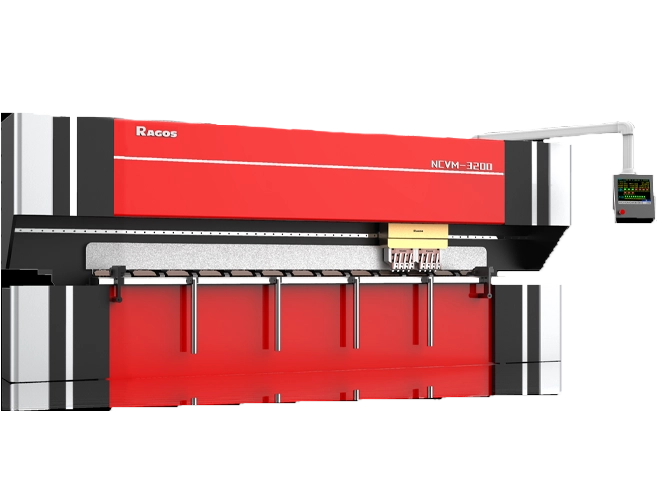
JSラゴスCNC press brake machines use servo-controlled hydraulic systems built to maintain consistent approach speeds across full production shifts — including under hot running conditions that affect older valve designs. For shops with specific output targets, custom press brake configurations allow approach speed, ストローク, and backgauge specs to be matched precisely to your production program.
Frequently Asked Questions About Fast Approach Speed Press Brakes
What is fast approach speed on a press brake?
Fast approach speed is the rate at which the press brake ram moves from top dead center down to the mute point — the position just above the material where the machine slows to bending speed. It is measured in mm/s and typically ranges from 100 宛先 250 mm/s on modern machines. A faster approach speed reduces the non-bending idle time between cycles, which directly increases parts-per-shift output.
How much does approach speed actually affect cycle time?
で 200 mm stroke, a 200 mm/s approach takes 1 second vs. 2 seconds at 100 mm/s. That 1-second difference per cycle adds up to 500 seconds of recovered production time across 500 cycles — without changing tooling, オペレーター, or material.
What approach speed should I expect from a hydraulic press brake?
Standard hydraulic press brakes deliver 100–150 mm/s. A well-built servo-hydraulic machine should reach 150–200 mm/s. Anything above 200 mm/s in a hydraulic machine requires premium servo-valve and pump control technology.
Do electric press brakes have faster approach speeds than hydraulic?
Electric press brakes achieve high approach speeds with more precise mute-point transitions, thanks to servo motor control. しかし, high-quality servo-hydraulic machines close the gap significantly. The electric advantage is more about acceleration consistency and thermal stability than raw peak speed.
Can approach speed be adjusted on a CNC press brake?
はい. Most CNC press brakes allow operators to set approach speed through the controller interface. Reducing approach speed on thin or delicate materials prevents mute-point overshoot and reduces tooling wear. For most standard production jobs, running at the maximum rated approach speed is the correct default.